
Manage Your Supplier Assessments by Context and Project for a 360° View

Unlock the Power of Context-Based Evaluations: Gain Clarity and Impact
Supplier assessments are often structured as a top-down relationship: from the client (or buyer) to a panel of suppliers. However, these suppliers frequently operate within shared contexts — whether that’s a product, a contract, or an entire supply chain.
Managing third-party evaluations by context gives you a broader view of internal company topics such as a product, a contract, or a sector.
Some practical use cases:
- Access all evaluations of tier-1 and beyond suppliers through a dedicated Aprovall space, centralizing all information related to your products.
- Manage an entire sector of suppliers sharing the same expertise via a unique workflow, tailored to that line of business (e.g., wood, water, raw materials).
- Orchestrate all suppliers linked to a contract by defining dedicated workflows and associated attributes for centralized and holistic management.
- Discover your subcontracting chain through third-party declarations themselves.
Organize and visualize third parties in line with your business structure (project, contract, sector, product, etc.). Customize evaluations (SmartFlow) by product, contract, subcontracting level, etc. Gain insights into your extended supply chain thanks to self-reporting from your suppliers.
Why Contextualizing Supplier Assessments with TPRM Changes Everything
A Vertical-Only Approach Falls Short
In many companies, supplier evaluations still follow a top-down model: the client triggers thorough evaluation workflows for a supplier panel, but often using a “one-supplier-at-a-time” lens.
This vertical logic quickly shows its limitations. Why? Because it doesn’t take into account the context in which suppliers operate. Yet a single supplier may be involved in a strategic project, be active in a critical supply chain, or tied to high-risk products. Overlooking this context means missing weak signals — and valuable performance levers.
Context Is the Key to More Relevant Assessments
Rather than assessing suppliers in isolation, it’s time to shift to a contextualized approach — attaching each evaluation workflow to a business object: a product, a contract, a sector, or even a region.
Why is this shift strategic? Because it allows you to:
- Better understand the operational reality behind supplier relationships,
- Align evaluations with the company’s internal priorities,
- Cross-reference risks with other dimensions: product criticality, contractual obligations, specific regulatory requirements, etc.
- Generate risk indicators by context or project.
A Cross-Functional, Actionable, and Scalable View
A contextual approach provides your teams with a cross-functional view rooted in real business activity. It’s no longer just about compliance or procurement: it becomes a strategic management tool.
Here are some concrete use cases, enabled by a platform like Aprovall:
By Product: Secure Your Value Chains
Launching a new strategic product or operating in a highly regulated industry? Use a dedicated dashboard to view all suppliers and subcontractors linked to that product — their compliance status, identified risks, active alerts… all the way to tier-3 if needed. This allows for proactive management of dependencies and better anticipation of disruptions or non-compliance.
By Contract: Coordinate All Involved Parties
A strategic contract involves multiple direct and indirect suppliers? Create a dedicated evaluation workflow linked to that contract. Define shared indicators, streamline required documents, and track the progress of assessments. You’ll harmonize processes and facilitate collaboration across departments (procurement, legal, project management…).
By Sector: Standardize Without Losing Relevance
Certain activities (water, wood, raw materials, logistics…) involve suppliers with similar constraints. By offering them an industry-specific evaluation workflow, you simplify their experience while collecting standardized, comparable data. This enables you to measure performance or compliance at the sector level.
By Subcontracting Tier: Uncover the Full Chain
Beyond tier-1 suppliers, it’s now critical to understand the true structure of your supply chain. Through third-party declarations, you gain access to a deeper map of your ecosystem, identifying bottlenecks and blind spots. A crucial step for managing ESG, cybersecurity, or geopolitical risks.
A Smoother, More Efficient Organization
In concrete terms, this approach translates into several structuring benefits:
- Greater clarity: evaluations are no longer scattered — they’re centralized by business object. Internal teams save time and work more effectively.
- Smart workflows (SmartFlow): processes adapt to context (product, contract, sector, subcontracting tier…), making evaluations more targeted, faster, and more useful.
- Stronger governance: you manage supplier risks with unmatched granularity while ensuring consistency in the data collected.
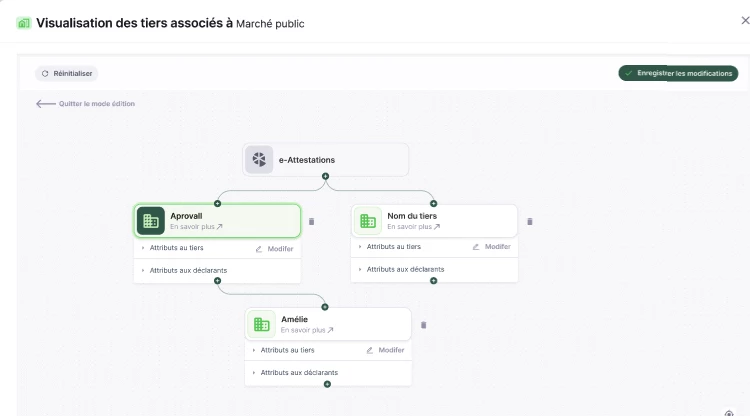
Discover how Aprovall gives you a new lens to evaluate third parties — through your own contexts and business projects.