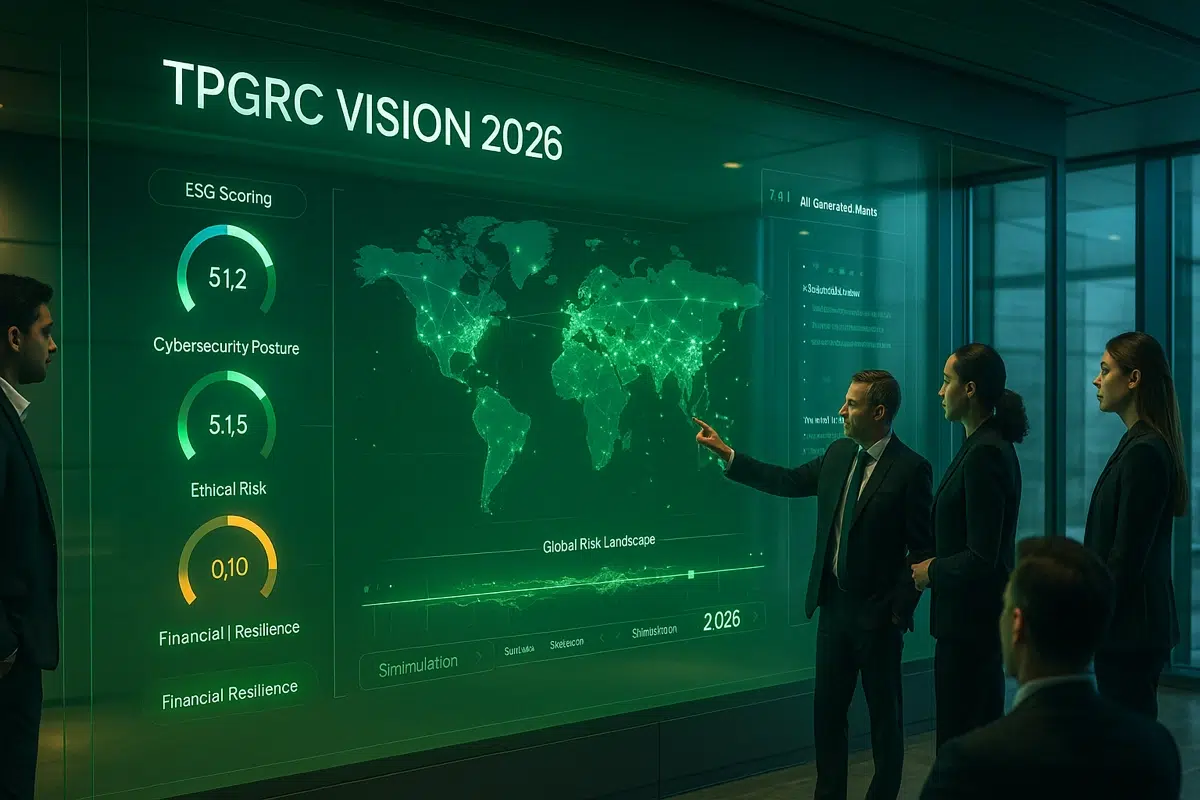
TPRM Visions 2026: Expanding the Evaluation Spectrum to Anticipate Emerging Risks
2026: A Turning Point in Third-Party Evaluation
Third-party management is undergoing a major transformation. Until now, companies have focused their evaluations on the most immediate risks: supplier financial stability, ethical compliance, and fraud prevention related to banking information. These areas remain critical. But by 2026, TPRM (Third Party Risk Management and Compliance) will broaden its scope to meet global challenges.
Procurement, compliance, and risk departments can no longer ignore the growing impact of cyberattacks, geopolitical tensions, or climate change on their supply chains.
Broader, Interconnected Risk Angles
Cyber Risks: Securing the Digital Supply Chain
Every supplier represents a potentially vulnerable link. By incorporating cybersecurity evaluations into your TPRM processes, you gain visibility into the digital resilience of your third parties and can identify weak points that may jeopardize your operations.
Geopolitical Risks: Anticipating Instability
Supply zones are evolving in a world where sanctions, conflicts, and regulatory shifts can disrupt entire sectors. TPRM platforms must now integrate such signals to guide strategic decisions—such as proactively relocating sourcing operations.
Climate Risks: Driving Sustainability
Energy dependency, resource scarcity, and natural disasters directly impact business continuity. Climate-related evaluation is becoming both a sustainability driver and a key differentiator in meeting ESG expectations.
These new perspectives add to the fundamentals:
Monitoring financial risks
Detecting banking fraud
Ensuring robust business ethics
Toward a Holistic, Actionable View of Third Parties – A Convergence of Risks
Embracing this expanded vision means shifting from a defensive posture to a proactive, strategic approach:
Cross-analyzing risks: A supplier may be financially sound but geopolitically exposed; or ethically compliant but weak in cybersecurity.
Contextualizing evaluations: Tailoring risk assessments by product, contract, region, or industry.
Data-driven decisions: Relying on dynamic, comparable, and up-to-date indicators to enable rapid arbitration.
Broadening the scope: Including upstream tiers in evaluations to map risk chains more comprehensively.
Artificial Intelligence & TPRM
AI is reshaping the way documentation and legal data are collected. This aspect of third-party evaluation is widely used across organizations, though many still rely on manual, time-consuming processes. With more third parties and increasingly complex regulations, companies face a growing volume of documents to manage. This is precisely where Artificial Intelligence plays a crucial role—automating document reading, extracting essential data, and even validating or flagging content.
2026: The Era of Augmented TPRM
In the near future, TPRM platforms like Aprovall will deliver extended, intelligent third-party governance—capable of uncovering hidden vulnerabilities, anticipating disruptions, and turning risk management into a sustainable competitive advantage.
By 2026, evaluating your third parties will no longer be about ticking boxes. It will mean mapping your dependencies, spotting vulnerabilities, and strengthening the overall resilience of your organization.
Watch the replay of our latest webinar on TPGRC Visions 2026: expanding the scope of assessments to anticipate 2026 risks